
THE PERFECT TABLE
Designing a gamified learning experience around food and the art of entertaining
My Role
Product Design
UI Visual Design
Art Direction
Tools
Sketch
ProtoPie
After Effects
Photoshop
The Core Team
Project GM
Lead PM
Content Manager
Lead Engineer
Overview
At Glu Mobile/EA, I led the design of a new lifestyle game built around a genuinely underexplored idea: that food is one of the most universal things people want to learn about, share, and get better at.
The core design challenge wasn't just making a fun game — it was figuring out how to embed real learning into a competitive experience. Players needed to actually learn: how to build balanced meals for different dietary needs, how to pair flavors and cuisines, and how to create a beautiful table setting using real lifestyle brands. That knowledge then had to feel meaningful and rewarding when applied under pressure in head-to-head challenges.
I served as both Creative Director and Art Director, leading concept development, UX, visual design, the full design system, and the 3D art pipeline — from early prototypes through to a playable Alpha.
The Design Challenge: Learning That Doesn’t Feel Like Learning
The insight from our early research was simple but generative: everyone has a food story, and most people are hungry to expand their knowledge — new cuisines, dietary considerations, how to cook for guests with different needs. But they don't want a cooking class. They want to play.
The central design problem became: how do you create a progression system where learning is the prerequisite for winning? We needed players to genuinely absorb knowledge about ingredients, flavor profiles, and dietary restrictions — not just click through content to unlock the next level.
This tension between learning depth and gameplay momentum shaped every major design decision that followed.
Early Prototyping & Direction Finding
Building on our studio's success with Covet Fashion and Design Home, we knew the lifestyle gaming market had appetite for something food-focused. We ran market research, user interviews, and focus groups to pressure-test the concept before committing to a direction.
We iterated rapidly across dozens of concepts — cooking class simulations, restaurant dining experiences, recipe collection mechanics, social dinner party formats. Each direction taught us something different about where learning and competition could coexist, and where one killed the other.
The cooking class format, for example, performed well on learning metrics in testing but felt passive — players didn't feel any stakes. The competitive dining format created great tension but left learning as an afterthought. The insight that unlocked our final direction: learning had to be the competitive advantage. Players who understood dietary restrictions, who knew how to balance a menu, who could create a cohesive table aesthetic — those players would win.
The final design structured gameplay in two phases: a learning phase where players absorbed recipes, ingredients, and styling knowledge, followed by competitive challenge rounds where that knowledge was tested by social comparison.
I led all UX across both phases, creating full user flows for both the meta game and the core interactions.
Designing the Learning Loop
The learning system had to do three things: introduce knowledge in context (not as abstract facts), create moments of application, and make mastery feel satisfying.
We structured content around real culinary scenarios — planning a dinner for guests with specific dietary needs, choosing ingredients that work across different flavor profiles, selecting tableware and decor from real lifestyle brands to create a coherent aesthetic. Each scenario introduced knowledge that players would immediately apply in the challenge that followed.
For example, as players leveled-up they unlocked cookbooks of recipes featuring a particular cultural cuisine, ingredient or cooking style. Then subsequent meal challenges in the same theme would give them the opportunity to use those new recipes.
User testing across iterations showed us that players who felt they'd learned something real were significantly more likely to return. The aspiration to actually get better — not just to win — was a stronger retention driver than competitive ranking alone.
Defining the UI Visual Style
One of the most important visual design decisions was tone. The UI needed to feel warm and welcoming — familiar to users of food and recipe apps — while still carrying the energy and feedback richness of a game. Too much game-UI chrome and it felt alienating to the lifestyle audience. Too editorial and it lost momentum.
I tested several visual directions with potential users before landing on an approach that balanced those needs. I then designed and executed the full design system, including all UI components, animation language, and the visual logic for the learning and challenge phases.
Where the tech platform didn't allow me to author animations directly, I built motion references in After Effects to align engineering on intent — including the challenge reward moment shown above.
Art Direction & Technical Strategy: Making Food Look Real
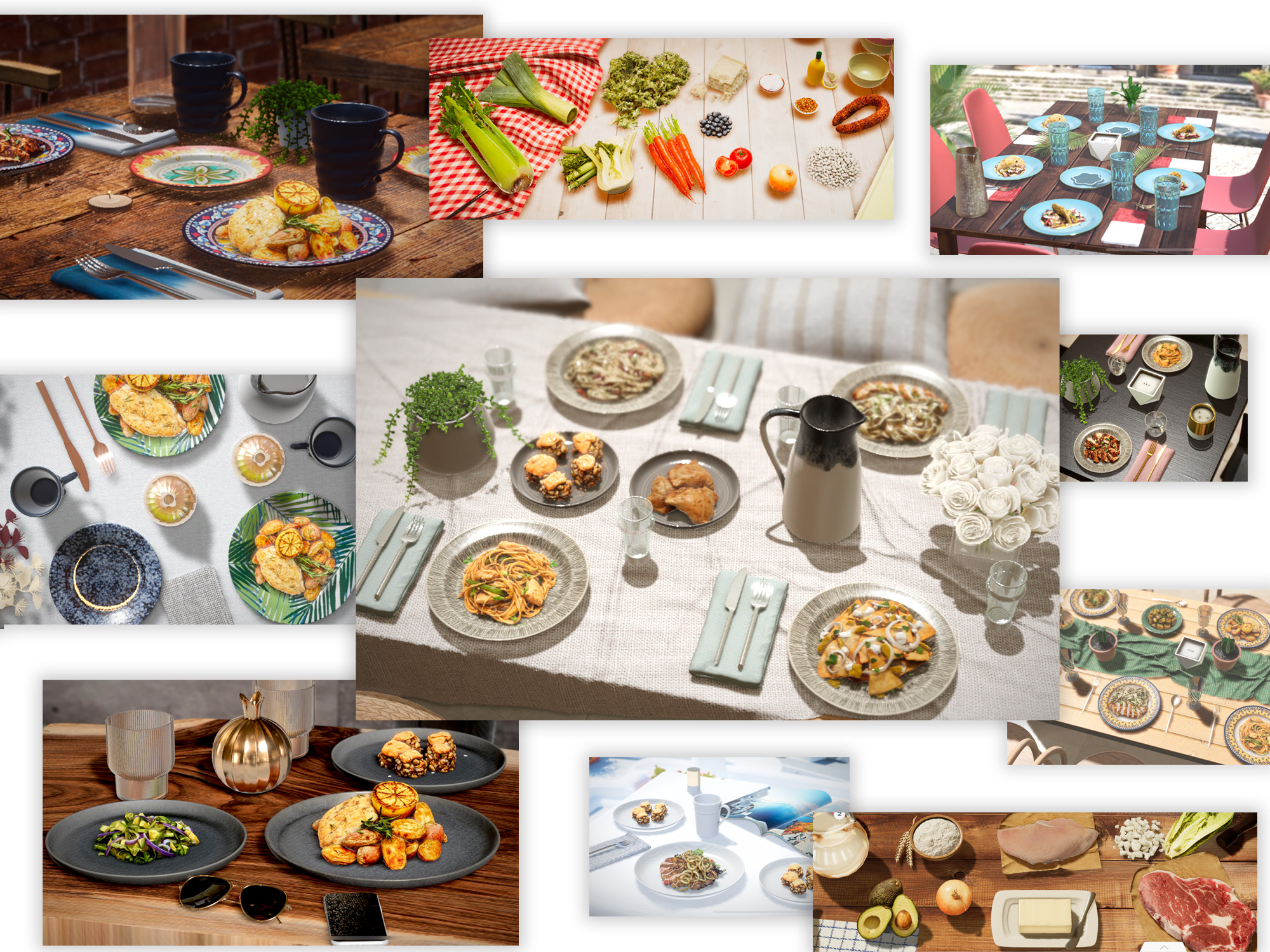
One of the most significant production challenges was 3D food. Appetizing, realistic food is genuinely hard to render — and the entire game's emotional proposition depended on it. Players had to look at the food and want it.
Acting as Art Director alongside my design role, I led an R&D initiative to find a viable technical approach — working with both internal teams and external partners to prototype different rendering and asset strategies.
The approach we developed became a scalable production pipeline, ultimately generating over 300 photorealistic 3D recipe and ingredient assets.
Reflection
This project taught me a lot about the relationship between engagement and learning — and how easily they can work against each other if you're not deliberate. Purely competitive systems create engagement but can hollow out learning. Purely instructional systems create knowledge but kill motivation. The design work I'm most proud of here is in the middle: the moments where a player wins specifically because they paid attention, and that felt meaningful rather than arbitrary.
That tension is one I find genuinely interesting — and it's directly relevant to the work I want to do in consumer-facing learning products.



George Rodgers
THE PERFECT TABLE
Designing a gamified learning experience around food and the art of entertaining
My Role
Product Design
UI Visual Design
Art Direction
Tools
Sketch
ProtoPie
After Effects
Photoshop
The Core Team
Project GM
Lead PM
Content Manager
Lead Engineer
Overview
At Glu Mobile/EA, I led the design of a new lifestyle game built around a genuinely underexplored idea: that food is one of the most universal things people want to learn about, share, and get better at.
The core design challenge wasn't just making a fun game — it was figuring out how to embed real learning into a competitive experience. Players needed to actually learn: how to build balanced meals for different dietary needs, how to pair flavors and cuisines, and how to create a beautiful table setting using real lifestyle brands. That knowledge then had to feel meaningful and rewarding when applied under pressure in head-to-head challenges.
I served as both Creative Director and Art Director, leading concept development, UX, visual design, the full design system, and the 3D art pipeline — from early prototypes through to a playable Alpha.
The Design Challenge: Learning That Doesn’t Feel Like Learning
The insight from our early research was simple but generative: everyone has a food story, and most people are hungry to expand their knowledge — new cuisines, dietary considerations, how to cook for guests with different needs. But they don't want a cooking class. They want to play.
The central design problem became: how do you create a progression system where learning is the prerequisite for winning? We needed players to genuinely absorb knowledge about ingredients, flavor profiles, and dietary restrictions — not just click through content to unlock the next level.
This tension between learning depth and gameplay momentum shaped every major design decision that followed.
Early Prototyping & Direction Finding
Building on our studio's success with Covet Fashion and Design Home, we knew the lifestyle gaming market had appetite for something food-focused. We ran market research, user interviews, and focus groups to pressure-test the concept before committing to a direction.
We iterated rapidly across dozens of concepts — cooking class simulations, restaurant dining experiences, recipe collection mechanics, social dinner party formats. Each direction taught us something different about where learning and competition could coexist, and where one killed the other.
The cooking class format, for example, performed well on learning metrics in testing but felt passive — players didn't feel any stakes. The competitive dining format created great tension but left learning as an afterthought. The insight that unlocked our final direction: learning had to be the competitive advantage. Players who understood dietary restrictions, who knew how to balance a menu, who could create a cohesive table aesthetic — those players would win.
The final design structured gameplay in two phases: a learning phase where players absorbed recipes, ingredients, and styling knowledge, followed by competitive challenge rounds where that knowledge was tested by social comparison.
I led all UX across both phases, creating full user flows for both the meta game and the core interactions.
Designing the Learning Loop
The learning system had to do three things: introduce knowledge in context (not as abstract facts), create moments of application, and make mastery feel satisfying.
We structured content around real culinary scenarios — planning a dinner for guests with specific dietary needs, choosing ingredients that work across different flavor profiles, selecting tableware and decor from real lifestyle brands to create a coherent aesthetic. Each scenario introduced knowledge that players would immediately apply in the challenge that followed.
For example, as players leveled-up they unlocked cookbooks of recipes featuring a particular cultural cuisine, ingredient or cooking style. Then subsequent meal challenges in the same theme would give them the opportunity to use those new recipes.
User testing across iterations showed us that players who felt they'd learned something real were significantly more likely to return. The aspiration to actually get better — not just to win — was a stronger retention driver than competitive ranking alone.
Defining the UI Visual Style
One of the most important visual design decisions was tone. The UI needed to feel warm and welcoming — familiar to users of food and recipe apps — while still carrying the energy and feedback richness of a game. Too much game-UI chrome and it felt alienating to the lifestyle audience. Too editorial and it lost momentum.
I tested several visual directions with potential users before landing on an approach that balanced those needs. I then designed and executed the full design system, including all UI components, animation language, and the visual logic for the learning and challenge phases.
Where the tech platform didn't allow me to author animations directly, I built motion references in After Effects to align engineering on intent — including the challenge reward moment shown above.
Art Direction & Technical Strategy: Making Food Look Real
One of the most significant production challenges was 3D food. Appetizing, realistic food is genuinely hard to render — and the entire game's emotional proposition depended on it. Players had to look at the food and want it.
Acting as Art Director alongside my design role, I led an R&D initiative to find a viable technical approach — working with both internal teams and external partners to prototype different rendering and asset strategies.
The approach we developed became a scalable production pipeline, ultimately generating over 300 photorealistic 3D recipe and ingredient assets.
Reflection
This project taught me a lot about the relationship between engagement and learning — and how easily they can work against each other if you're not deliberate. Purely competitive systems create engagement but can hollow out learning. Purely instructional systems create knowledge but kill motivation. The design work I'm most proud of here is in the middle: the moments where a player wins specifically because they paid attention, and that felt meaningful rather than arbitrary.
That tension is one I find genuinely interesting — and it's directly relevant to the work I want to do in consumer-facing learning products.

THE PERFECT TABLE
Designing a gamified learning experience around food and the art of entertaining
My Role
Product Design
UI Visual Design
Art Direction
Tools
Sketch
ProtoPie
After Effects
Photoshop
The Core Team
Project GM
Lead PM
Content Manager
Lead Engineer
Overview
At Glu Mobile/EA, I led the design of a new lifestyle game built around a genuinely underexplored idea: that food is one of the most universal things people want to learn about, share, and get better at.
The core design challenge wasn't just making a fun game — it was figuring out how to embed real learning into a competitive experience. Players needed to actually learn: how to build balanced meals for different dietary needs, how to pair flavors and cuisines, and how to create a beautiful table setting using real lifestyle brands. That knowledge then had to feel meaningful and rewarding when applied under pressure in head-to-head challenges.
I served as both Creative Director and Art Director, leading concept development, UX, visual design, the full design system, and the 3D art pipeline — from early prototypes through to a playable Alpha.
The Design Challenge: Learning That Doesn’t Feel Like Learning
The insight from our early research was simple but generative: everyone has a food story, and most people are hungry to expand their knowledge — new cuisines, dietary considerations, how to cook for guests with different needs. But they don't want a cooking class. They want to play.
The central design problem became: how do you create a progression system where learning is the prerequisite for winning? We needed players to genuinely absorb knowledge about ingredients, flavor profiles, and dietary restrictions — not just click through content to unlock the next level.
This tension between learning depth and gameplay momentum shaped every major design decision that followed.
Early Prototyping & Direction Finding
Building on our studio's success with Covet Fashion and Design Home, we knew the lifestyle gaming market had appetite for something food-focused. We ran market research, user interviews, and focus groups to pressure-test the concept before committing to a direction.
We iterated rapidly across dozens of concepts — cooking class simulations, restaurant dining experiences, recipe collection mechanics, social dinner party formats. Each direction taught us something different about where learning and competition could coexist, and where one killed the other.
The cooking class format, for example, performed well on learning metrics in testing but felt passive — players didn't feel any stakes. The competitive dining format created great tension but left learning as an afterthought. The insight that unlocked our final direction: learning had to be the competitive advantage. Players who understood dietary restrictions, who knew how to balance a menu, who could create a cohesive table aesthetic — those players would win.
The final design structured gameplay in two phases: a learning phase where players absorbed recipes, ingredients, and styling knowledge, followed by competitive challenge rounds where that knowledge was tested by social comparison.
I led all UX across both phases, creating full user flows for both the meta game and the core interactions.
Designing the Learning Loop
The learning system had to do three things: introduce knowledge in context (not as abstract facts), create moments of application, and make mastery feel satisfying.
We structured content around real culinary scenarios — planning a dinner for guests with specific dietary needs, choosing ingredients that work across different flavor profiles, selecting tableware and decor from real lifestyle brands to create a coherent aesthetic. Each scenario introduced knowledge that players would immediately apply in the challenge that followed.
For example, as players leveled-up they unlocked cookbooks of recipes featuring a particular cultural cuisine, ingredient or cooking style. Then subsequent meal challenges in the same theme would give them the opportunity to use those new recipes.
User testing across iterations showed us that players who felt they'd learned something real were significantly more likely to return. The aspiration to actually get better — not just to win — was a stronger retention driver than competitive ranking alone.
Defining the UI Visual Style
One of the most important visual design decisions was tone. The UI needed to feel warm and welcoming — familiar to users of food and recipe apps — while still carrying the energy and feedback richness of a game. Too much game-UI chrome and it felt alienating to the lifestyle audience. Too editorial and it lost momentum.
I tested several visual directions with potential users before landing on an approach that balanced those needs. I then designed and executed the full design system, including all UI components, animation language, and the visual logic for the learning and challenge phases.
Where the tech platform didn't allow me to author animations directly, I built motion references in After Effects to align engineering on intent — including the challenge reward moment shown above.
Art Direction & Technical Strategy: Making Food Look Real
One of the most significant production challenges was 3D food. Appetizing, realistic food is genuinely hard to render — and the entire game's emotional proposition depended on it. Players had to look at the food and want it.
Acting as Art Director alongside my design role, I led an R&D initiative to find a viable technical approach — working with both internal teams and external partners to prototype different rendering and asset strategies.
The approach we developed became a scalable production pipeline, ultimately generating over 300 photorealistic 3D recipe and ingredient assets.
Reflection
This project taught me a lot about the relationship between engagement and learning — and how easily they can work against each other if you're not deliberate. Purely competitive systems create engagement but can hollow out learning. Purely instructional systems create knowledge but kill motivation. The design work I'm most proud of here is in the middle: the moments where a player wins specifically because they paid attention, and that felt meaningful rather than arbitrary.
That tension is one I find genuinely interesting — and it's directly relevant to the work I want to do in consumer-facing learning products.